Market Research Report

Sustainable Aviation Fuel Market Outlook 2025–2034: Growth Drivers, Trends & Opportunities

  • AMR ID : 1-30
  • CAT ID : 9
  • Pages : 204
  • Date : Sep 2025
 

Sustainable Aviation Fuel Market Size, Share & Growth Forecast (2025–2034)

The global sustainable aviation fuel (SAF) market was valued at around USD 1.71 billion in 2024 and is projected to grow rapidly, reaching nearly USD 75 billion by 2034. The market is expected to expand at a strong CAGR of about 46.8% during the forecast period, driven by aviation decarbonization targets and rising adoption of low-carbon fuels.

Airlines, governments, and fuel producers are increasingly focusing on SAF to reduce lifecycle carbon emissions. SAF can cut emissions by up to 80% compared to conventional jet fuel, making it a critical solution for achieving net-zero aviation targets by 2050.
Sustainable Aviation Fuel Market


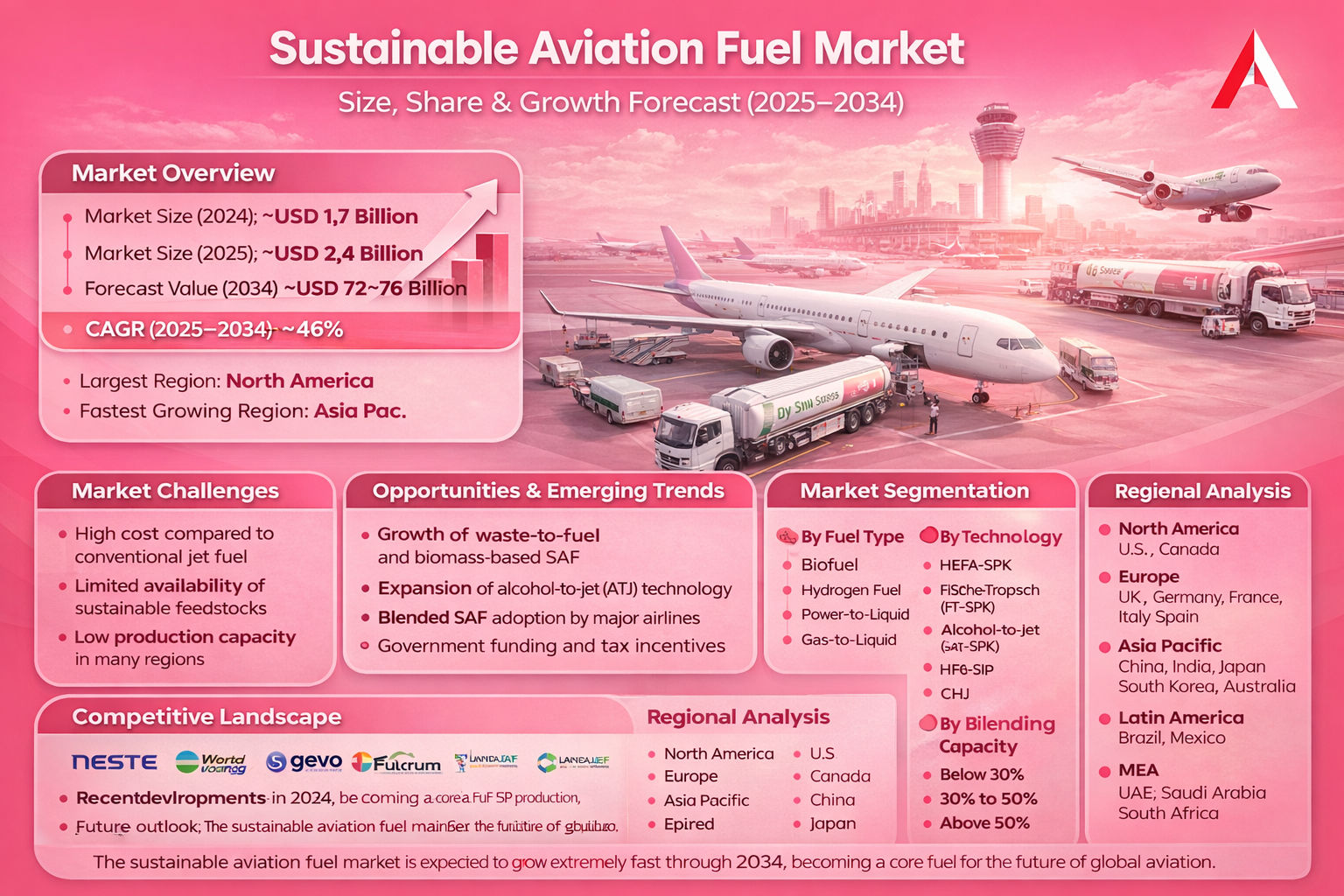
Market Overview

  • Market Size (2024): ~USD 1.71 Billion
  • Market Size (2025): ~USD 2.4 Billion
  • Forecast Value (2034): ~USD 72–76 Billion
  • CAGR (2025–2034): ~46.8%
  • Largest Region: North America
  • Fastest Growing Region: Asia Pacific

Key Market Drivers

The push toward carbon-neutral aviation is the biggest driver of the SAF market. Airlines are under pressure from governments, regulators, and customers to reduce emissions.

  • Net-zero targets by airlines and aviation authorities
  • Government mandates for SAF blending
  • Rising consumer preference for eco-friendly travel
  • Growth in air passenger traffic worldwide
  • Investment in green aviation technologies

Market Challenges

Despite strong demand, SAF adoption is limited by high production costs and feedstock availability.

  • High cost compared to conventional jet fuel
  • Limited availability of sustainable feedstocks
  • Low production capacity in many regions
  • Infrastructure and supply-chain constraints

Opportunities & Emerging Trends

New technologies and partnerships are helping scale SAF production. Waste-based fuels, alcohol-to-jet pathways, and hydrogen-based fuels are gaining traction.

  • Growth of waste-to-fuel and biomass-based SAF
  • Expansion of alcohol-to-jet (ATJ) technology
  • Blended SAF adoption by major airlines
  • Government funding and tax incentives

Market Segmentation

By Fuel Type

  • Biofuel (largest segment)
  • Hydrogen Fuel
  • Power-to-Liquid
  • Gas-to-Liquid

By Technology

  • HEFA-SPK (Hydroprocessed Esters and Fatty Acids)
  • Fischer-Tropsch (FT-SPK)
  • Alcohol-to-Jet (ATJ-SPK)
  • HFS-SIP
  • CHJ

By Blending Capacity

  • Below 30%
  • 30% to 50%
  • Above 50%

By End Use

  • Large Airlines
  • Medium Airlines
  • Small Airlines
  • Non-Scheduled Operators
  • Government & Military

Market Segment Insights

Fuel Type: Biofuels dominate with over 90% share due to compatibility with existing aircraft engines.

Technology: HEFA-SPK is the fastest-growing technology as it uses waste oils and fats.

End Use: Large commercial airlines are the biggest consumers of SAF.


Regional Analysis

North America leads the SAF market due to strong government incentives and airline partnerships in the U.S. and Canada.

Europe is growing rapidly with strict emission rules and strong focus on sustainable aviation.

Asia Pacific is the fastest-growing region due to expanding aviation sectors in China, India, and Southeast Asia.

Middle East & Africa and Latin America are emerging markets supported by government initiatives and airline investments.


Competitive Landscape

The SAF market is moderately competitive, with companies focusing on waste-based fuels, alcohol-to-jet technology, and strategic airline partnerships.

Key Companies

  • Neste
  • World Energy
  • Gevo
  • Fulcrum BioEnergy
  • LanzaJet
  • Shell Aviation
  • TotalEnergies
  • BP
  • Alder Energy
  • USA BioEnergy

Recent Developments

  • In 2024, Airbus invested in LanzaJet to scale alcohol-to-jet SAF production.
  • In 2024, Airbus and TotalEnergies partnered to accelerate SAF adoption.
  • Emirates and Neste expanded SAF supply for flights in Europe and Asia.
  • Fulcrum BioEnergy launched large-scale waste-to-fuel projects in the U.S.
  • Several governments announced subsidies and tax credits for SAF.

Future Outlook

The sustainable aviation fuel market is expected to grow extremely fast through 2034. Strong regulations, rising airline commitments, and technological progress will drive large-scale adoption of SAF, making it a core fuel for the future of global aviation.

Regional Outlook

  • North America
    • U.S.
    • Canada
  • Europe
    • UK
    • Germany
    • France
    • Italy
    • Spain
  • Asia Pacific
    • China
    • India
    • Japan
    • South Korea
    • Australia
  • Latin America
    • Brazil
    • Mexico
  • MEA
    • UAE
    • Saudi Arabia
    • South Africa

Table of Contents


  1. Introduction

    1. Market Definition

    2. Scope of the Report

    3. Research Methodology

    4. Assumptions & Limitations


  2. Executive Summary

    1. Global Sustainable Aviation Fuel Market Snapshot

    2. Key Market Highlights

    3. Market Size & Growth Outlook (2025–2034)


  3. Sustainable Aviation Fuel Market Overview

    1. Industry Value Chain Analysis

    2. Market Ecosystem

    3. Pricing Analysis


  4. Market Dynamics

    1. Market Drivers

    2. Market Restraints

    3. Market Opportunities

    4. Market Challenges


  5. Sustainable Aviation Fuel Market Trends

    1. Growth of Bio-Based SAF

    2. Rise of Alcohol-to-Jet Technology

    3. Strategic Airline–Fuel Producer Partnerships


  6. Sustainable Aviation Fuel Market Size & Forecast (2025–2034)

  7. Market Segmentation, By Fuel Type

    1. Biofuel

    2. Hydrogen Fuel

    3. Power-to-Liquid

    4. Gas-to-Liquid


  8. Market Segmentation, By Technology

    1. HEFA-SPK

    2. FT-SPK

    3. ATJ-SPK

    4. HFS-SIP

    5. CHJ


  9. Market Segmentation, By Blending Capacity

    1. Below 30%

    2. 30% to 50%

    3. Above 50%


  10. Market Segmentation, By End Use

    1. Large Airlines

    2. Medium Airlines

    3. Small Airlines

    4. Non-Scheduled Operators

    5. Government & Military


  11. Regional Analysis

    1. North America

    2. Europe

    3. Asia Pacific

    4. Latin America

    5. Middle East & Africa


  12. Country-Level Market Analysis

    1. United States

    2. Canada

    3. Germany

    4. United Kingdom

    5. France

    6. China

    7. India

    8. Japan

    9. Brazil

    10. UAE


  13. Competitive Landscape

    1. Market Share Analysis

    2. Competitive Benchmarking

    3. Strategic Developments


  14. Sustainable Aviation Fuel Market Companies

    1. Company Overview

    2. Product Portfolio

    3. Strategic Initiatives


  15. Investment & Growth Opportunities

  16. Analyst Viewpoint

  17. Future Outlook

  18. Appendix

    1. Abbreviations

    2. Research Sources

    3. Disclaimer


Choose License Type

Single User : $2800


Corporate User : $4800


Need a Tailored Report?

Customize this report to your needs — add regions, segments, or data points, with 20% free customization.

Customize This Report

Frequently Asked Questions

The report efficiently evaluates the market from various dimensions to deliver an end-product that is informative, elaborate, and accurate and includes detailed market segmentation, regional analysis, and competitive landscape of the industry.
The report efficiently evaluates the current market size and provides industry forecast. The market was valued at xx Million US$ in 2019, and is expected to grow at a CAGR of xx% during the period 2020-2027.
The report efficiently evaluates the current market size and provides forecast for the industry in terms of Value (US$ Mn) and Volume (Thousands Units).
Market is segmented by Types, Applications, Technology, End-use Industries, and Regions.
The report presents the current market size, and market forecast, market opportunities, key drivers and restraints, regulatory scenario, industry trend, PESTLE analysis, PORTER’s analysis, new product approvals/launch, promotion and marketing initiatives, pricing analysis, competitive landscape which help businesses in decision making. The analysis data is based on current and historical market trends which help in investment related decisions.
Custom research is crucial components of the business strategy which helps any organization to gain insight into specific business sector, aligned with specific area of interest. Thus, SMI offers more accurate, pragmatic, and actionable information specifically tailored to suit your business needs.

Subscribe Newsletter

  Subscribe