
Market Research Report

Recycled Carbon Fiber Market Size, Share, Trends & Growth Forecast 2025–2034

  • AMR ID : 1-43
  • CAT ID : 6
  • Pages : 220
  • Date : Jan 2026
 

Recycled Carbon Fiber Market Report: Size, Trends, Applications & Growth Forecast 2025–2034

Recycled Carbon Fiber Market Size

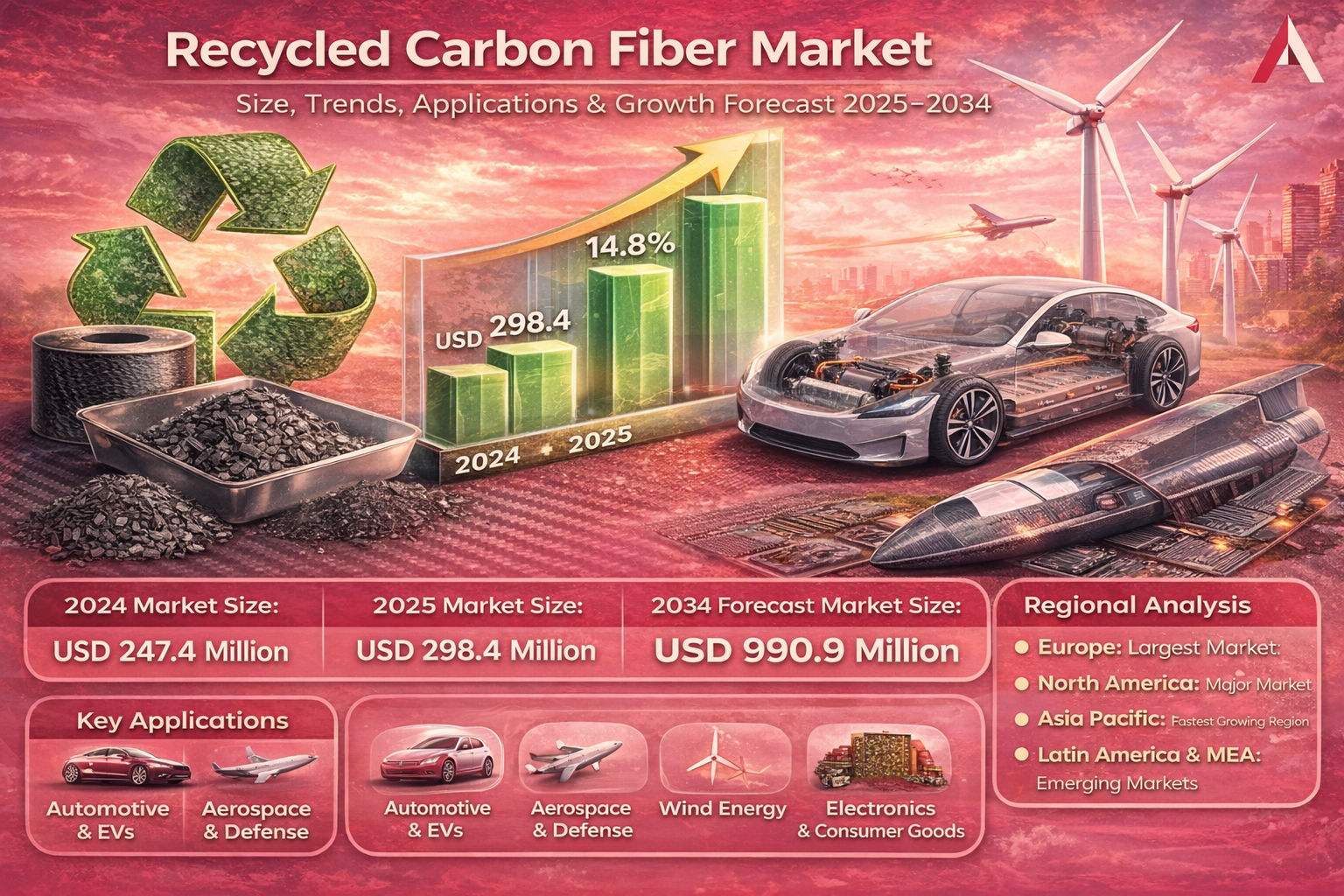
The global recycled carbon fiber market was valued at around USD 247.4 million in 2024 and is projected to grow from nearly USD 298.4 million in 2025 to approximately USD 990.9 million by 2034, expanding at a CAGR of about 14.8% during the forecast period. This growth is driven by rising focus on sustainability, circular economy regulations, and strong demand for lightweight materials in automotive, aerospace, and renewable energy sectors.

Recycled Carbon Fiber Market

High production costs and energy usage of virgin carbon fiber have made recycling an attractive alternative. Over the last few years, recycled carbon fiber (rCF) has moved from niche usage to scalable commercial adoption, especially in electric vehicles, wind energy components, and consumer products.

Recycled Carbon Fiber Market Overview

Recycled carbon fiber is produced by recovering fibers from carbon fiber reinforced polymer (CFRP) waste through processes such as pyrolysis, solvolysis, and mechanical recycling. Compared to virgin carbon fiber, recycled fiber can reduce material cost by up to 70–90% and lower energy consumption significantly.

Industries are increasingly integrating rCF to meet sustainability goals, reduce landfill waste, and comply with environmental regulations. The market has benefited strongly from EV production growth, wind turbine decommissioning, and stricter waste management policies across Europe and North America.
https://ik.imagekit.io/ybmffgyoj/AMR/Recycled%20Carbon%20Fiber%20Market%20table.png

Market Dynamics

Drivers

  • Rising demand for lightweight materials in EVs and transportation
  • Government regulations supporting circular economy models
  • Large volume of composite waste from aerospace, automotive, and wind energy
  • Cost advantage over virgin carbon fiber

Restraints

  • Inconsistent fiber quality and length
  • Limited large-scale recycling infrastructure
  • Challenges in resin compatibility

Opportunities

  • Rapid growth of electric vehicles and battery enclosures
  • Wind turbine blade recycling programs
  • Technological improvements in solvolysis and pyrolysis
  • Use in construction and consumer electronics

Recycled Carbon Fiber Market Trends

Automotive manufacturers are increasingly adopting recycled carbon fiber to reduce vehicle weight and improve battery range in electric vehicles. Major OEMs are testing rCF in interior panels, battery casings, and underbody structures.

Aerospace companies are using rCF mainly in non-structural parts such as cabin interiors, seat frames, and tray tables to reduce carbon footprint. Wind energy recycling is also gaining momentum, with old turbine blades being processed into rCF mats and chopped fibers.

Advancements in low-temperature pyrolysis and chemical recycling have improved fiber strength retention, enabling near-virgin quality rCF for high-performance applications.

Recycled Carbon Fiber Market Segmentation

By Product Type

  • Chopped Carbon Fiber
  • Milled Carbon Fiber
  • Carbon Fiber Mats & Non-wovens
  • Others

Chopped and milled fibers dominate the market due to easy blending with thermoplastics for injection molding. Carbon fiber mats are growing in EV battery housings, marine panels, and construction insulation.

By Source

  • Aerospace Scrap
  • Automotive Scrap
  • Wind Turbine Blades
  • Industrial Composite Waste

By Recycling Method

  • Pyrolysis
  • Solvolysis
  • Mechanical Recycling
  • Chemical Recycling

By Application

  • Automotive & Electric Vehicles
  • Aerospace & Defense
  • Wind Energy
  • Construction
  • Sports & Leisure
  • Electronics

Application Analysis

Automotive: The largest application segment, using rCF in brackets, battery housings, interiors, and lightweight body parts. EV growth is the main driver.

Aerospace: Mainly used in cabin interiors and non-critical components for sustainability targets.

Wind Energy: Old turbine blades are recycled into mats and chopped fibers for construction panels and insulation.

Construction: Used in fiber-reinforced concrete, wall panels, and insulation materials.

Sports & Electronics: Used in bicycles, helmets, phone casings, laptops, and consumer gadgets for strength and premium finish.

Regional Analysis

Europe

Europe is the largest market, driven by strong automotive and aerospace industries and strict recycling regulations. Germany, France, and the UK lead adoption due to EV manufacturing and EU Green Deal initiatives.

North America

The U.S. is a major market due to EV production, aerospace scrap availability, and DOE-supported recycling programs.

Asia-Pacific

Fastest-growing region led by China, Japan, and South Korea, driven by electronics, EV production, and wind energy expansion.

Latin America & MEA

Brazil and GCC countries are emerging markets, driven by construction, renewable energy projects, and sustainability initiatives.

Recycled Carbon Fiber Market Share

The market is moderately consolidated. Top players control more than half of global revenue, supported by advanced recycling technology, OEM partnerships, and scalable production systems.

Recycled Carbon Fiber Market Companies

  • Gen 2 Carbon
  • SGL Carbon
  • Toray Industries
  • Carbon Conversions
  • Vartega

Company Overview

Gen 2 Carbon: Leading supplier with strong presence in aerospace and automotive, known for advanced pyrolysis technology.

SGL Carbon: Focuses on nonwoven mats and chopped fibers for wind energy and automotive interiors.

Toray Industries: Expanding recycled fiber portfolio for electronics and automotive through chemical recycling.

Carbon Conversions: Specializes in aerospace scrap recovery and high-strength recycled fibers.

Vartega: Produces low-cost rCF for EVs, sporting goods, and consumer products.

Recent Developments

  • 2024 – Vartega partnered with automotive suppliers to supply recycled carbon fiber for EV interiors.
  • 2024 – Toray launched a pilot solvolysis plant in Japan for high-quality rCF.
  • 2023 – SGL Carbon expanded mat production in Germany for wind energy and automotive markets.
  • 2023 – Gen 2 Carbon increased capacity to support European EV manufacturers.

Future Outlook

The recycled carbon fiber market will witness strong long-term growth as industries focus on lightweighting, sustainability, and circular manufacturing. Advancements in recycling technology, increasing EV production, and stricter waste regulations will continue to push rCF into mainstream industrial use. Over the next decade, recycled carbon fiber is expected to become a standard alternative to virgin fiber in many semi-structural and consumer applications.

Recycled Carbon Fiber Market – Table of Contents


  • 1. Introduction

    • 1.1 Market Definition

    • 1.2 Scope of the Study

    • 1.3 Research Methodology

    • 1.4 Assumptions & Limitations


  • 2. Executive Summary

    • 2.1 Global Recycled Carbon Fiber Market Snapshot

    • 2.2 Key Market Highlights

    • 2.3 Market Size & Growth Outlook


  • 3. Recycled Carbon Fiber Market Overview

    • 3.1 Industry Value Chain Analysis

    • 3.2 Market Ecosystem

    • 3.3 Pricing Analysis


  • 4. Market Dynamics

    • 4.1 Market Drivers

    • 4.2 Market Restraints

    • 4.3 Market Opportunities

    • 4.4 Market Challenges


  • 5. Recycled Carbon Fiber Market Trends

    • 5.1 Circular Economy & Sustainability Initiatives

    • 5.2 EV Lightweighting Demand

    • 5.3 Wind Turbine Blade Recycling

    • 5.4 Advances in Pyrolysis & Solvolysis


  • 6. Recycled Carbon Fiber Market Size & Forecast (2025–2034)

  • 7. Market Segmentation by Product Type

    • 7.1 Chopped Carbon Fiber

    • 7.2 Milled Carbon Fiber

    • 7.3 Carbon Fiber Mats & Nonwovens

    • 7.4 Others


  • 8. Market Segmentation by Source

    • 8.1 Aerospace Scrap

    • 8.2 Automotive Scrap

    • 8.3 Wind Turbine Blades

    • 8.4 Industrial Composite Waste


  • 9. Market Segmentation by Recycling Method

    • 9.1 Pyrolysis

    • 9.2 Solvolysis

    • 9.3 Mechanical Recycling

    • 9.4 Chemical Recycling


  • 10. Market Segmentation by Application

    • 10.1 Automotive & Electric Vehicles

    • 10.2 Aerospace & Defense

    • 10.3 Wind Energy

    • 10.4 Construction

    • 10.5 Sports & Leisure

    • 10.6 Electronics


  • 11. Regional Analysis

    • 11.1 North America

    • 11.2 Europe

    • 11.3 Asia Pacific

    • 11.4 Latin America

    • 11.5 Middle East & Africa


  • 12. Country-Level Analysis

    • 12.1 United States

    • 12.2 Germany

    • 12.3 UK

    • 12.4 France

    • 12.5 China

    • 12.6 Japan

    • 12.7 India

    • 12.8 Brazil

    • 12.9 UAE


  • 13. Competitive Landscape

    • 13.1 Market Share Analysis

    • 13.2 Competitive Benchmarking

    • 13.3 Strategic Developments


  • 14. Recycled Carbon Fiber Market Companies

    • 14.1 Company Profiles

    • 14.2 Product Portfolio

    • 14.3 Business Strategies


  • 15. Recent Developments in Recycled Carbon Fiber Industry

  • 16. Investment & Growth Opportunities

  • 17. Analyst Viewpoint

  • 18. Future Outlook

  • 19. Appendix

    • 19.1 Abbreviations

    • 19.2 Research Sources

    • 19.3 Disclaimer


Choose License Type

Single User : $3200


Corporate User : $4800


Need a Tailored Report?

Customize this report to your needs — add regions, segments, or data points, with 20% free customization.

Customize This Report

Frequently Asked Questions

The report efficiently evaluates the market from various dimensions to deliver an end-product that is informative, elaborate, and accurate and includes detailed market segmentation, regional analysis, and competitive landscape of the industry.
The report efficiently evaluates the current market size and provides industry forecast. The market was valued at xx Million US$ in 2019, and is expected to grow at a CAGR of xx% during the period 2020-2027.
The report efficiently evaluates the current market size and provides forecast for the industry in terms of Value (US$ Mn) and Volume (Thousands Units).
Market is segmented by Types, Applications, Technology, End-use Industries, and Regions.
The report presents the current market size, and market forecast, market opportunities, key drivers and restraints, regulatory scenario, industry trend, PESTLE analysis, PORTER’s analysis, new product approvals/launch, promotion and marketing initiatives, pricing analysis, competitive landscape which help businesses in decision making. The analysis data is based on current and historical market trends which help in investment related decisions.
Custom research is crucial components of the business strategy which helps any organization to gain insight into specific business sector, aligned with specific area of interest. Thus, SMI offers more accurate, pragmatic, and actionable information specifically tailored to suit your business needs.

Subscribe Newsletter

  Subscribe