
Market Research Report

Phase Change Materials in Thermal Management Market Size, Share & Growth Forecast (2025–2034)

  • AMR ID : 1-38
  • CAT ID : 6
  • Pages : 245
  • Date : Aug 2025
 

Phase Change Materials in Thermal Management Market Size, Share & Growth Forecast (2025–2034)

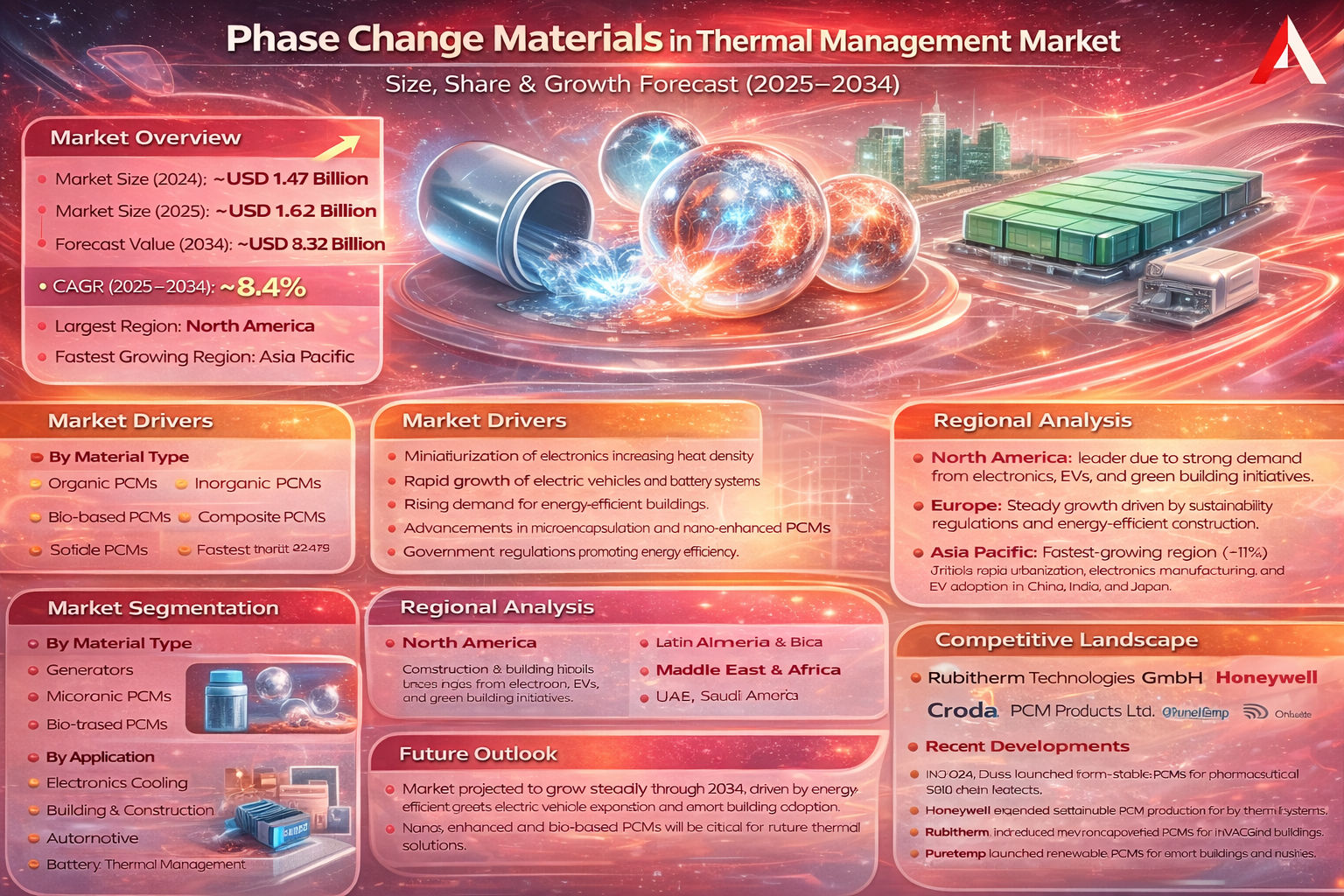
The global phase change materials in thermal management market was valued at nearly USD 1.47 billion in 2024 and is projected to grow from about USD 1.62 billion in 2025 to around USD 3.32 billion by 2034, expanding at a CAGR of nearly 8.4% during the forecast period.

Rising demand for efficient heat control in electronics, electric vehicles, construction, and energy systems is driving the adoption of phase change materials (PCMs). These materials absorb and release heat during phase transitions, enabling stable temperature regulation and improved energy efficiency.
Phase Change Materials in Thermal Management Market


Market Overview

  • Market Size (2024): ~USD 1.47 Billion
  • Market Size (2025): ~USD 1.62 Billion
  • Forecast Value (2034): ~USD 3.32 Billion
  • CAGR (2025–2034): ~8.4%
  • Largest Region: North America
  • Fastest Growing Region: Asia Pacific

Market Drivers

The market is gaining momentum due to the growing need for energy-efficient thermal management across industries.

  • Miniaturization of electronics increasing heat density
  • Rapid growth of electric vehicles and battery systems
  • Rising demand for energy-efficient buildings
  • Advancements in microencapsulation and nano-enhanced PCMs
  • Government regulations promoting energy efficiency

Market Challenges

Despite strong demand, some technical and economic barriers still limit adoption.

  • High production and integration costs
  • Material stability and lifecycle degradation
  • Complex manufacturing processes
  • Limited awareness in emerging markets

Opportunities & Emerging Trends

Technological innovation is opening new growth avenues for PCM-based thermal solutions.

  • Microencapsulated PCMs for electronics and textiles
  • Nano-enhanced PCMs for higher thermal conductivity
  • Smart building materials with embedded PCMs
  • Wearable and smart textile applications
  • Hybrid cooling systems combining PCMs with active cooling

Market Segmentation

By Material Type

  • Organic PCMs
  • Inorganic PCMs
  • Bio-based PCMs
  • Composite & Enhanced PCMs

By Application

  • Electronics Cooling
  • Building & Construction
  • Automotive
  • Battery Thermal Management
  • Textiles & Wearables
  • Cold Chain & Logistics

By Form Factor

  • Bulk & Raw PCMs
  • Microencapsulated PCMs
  • Macroencapsulated PCMs
  • Shape-Stabilized PCMs

By End-Use Industry

  • Construction & Building Materials
  • Electronics & Semiconductors
  • Automotive & Transportation
  • Energy & Utilities
  • Aerospace & Defense
  • Healthcare & Pharmaceuticals

By Temperature Range

  • Low Temperature (-50°C to 15°C)
  • Comfort Range (15°C to 32°C)
  • Medium Temperature (32°C to 100°C)
  • High Temperature (100°C to 800°C)

Regional Analysis

North America leads the market due to strong demand from electronics, EVs, and green building initiatives.

Europe shows steady growth driven by sustainability regulations and energy-efficient construction.

Asia Pacific is the fastest-growing region due to rapid urbanization, electronics manufacturing, and EV adoption in China, India, and Japan.

Latin America is expanding through cold chain logistics and agriculture applications.

Middle East & Africa is emerging due to smart city and green building projects, especially in UAE and Saudi Arabia.


Competitive Landscape

The PCM thermal management market is moderately consolidated, with companies focusing on sustainability, encapsulation technology, and customized thermal solutions.

Key Companies

  • Rubitherm Technologies GmbH
  • Honeywell International Inc.
  • Croda International Plc
  • Phase Change Material Products Ltd. (PlusICE)
  • Entropy Solutions Inc. / PureTemp LLC
  • Pluss Advanced Technologies
  • Outlast Technologies
  • Sunamp

Recent Developments

  • In 2024, Pluss launched form-stable PCMs for pharmaceutical cold chain logistics.
  • Honeywell expanded sustainable PCM production for EV thermal systems.
  • Rubitherm introduced new encapsulated PCMs for HVAC and buildings.
  • PureTemp launched renewable PCMs for smart buildings and textiles.
  • Several firms partnered with EV manufacturers for battery cooling solutions.

Future Outlook

The phase change materials in thermal management market will continue to grow through 2034, supported by energy efficiency goals, electric vehicle expansion, and smart building adoption. Innovations in nano-enhanced and bio-based PCMs will play a critical role in shaping future thermal management solutions.


Regional Coverage

  • North America
    • U.S.
    • Canada
  • Europe
    • Germany
    • UK
    • France
    • Italy
    • Spain
  • Asia Pacific
    • China
    • India
    • Japan
    • Australia
    • South Korea
  • Latin America
    • Brazil
    • Mexico
    • Argentina
  • Middle East & Africa
    • UAE
    • Saudi Arabia
    • South Africa

Phase Change Materials in Thermal Management Market – Table of Contents


  • 1. Introduction

    • 1.1 Market Definition

    • 1.2 Scope of the Study

    • 1.3 Research Methodology

    • 1.4 Assumptions & Limitations


  • 2. Executive Summary

    • 2.1 Global PCM Thermal Management Market Snapshot

    • 2.2 Key Market Highlights

    • 2.3 Market Size & Growth Outlook


  • 3. Market Overview

    • 3.1 Industry Value Chain Analysis

    • 3.2 Market Ecosystem

    • 3.3 Pricing Analysis

    • 3.4 Technology Landscape


  • 4. Market Dynamics

    • 4.1 Market Drivers

    • 4.2 Market Restraints

    • 4.3 Market Opportunities

    • 4.4 Market Challenges


  • 5. Phase Change Materials in Thermal Management Market Trends

    • 5.1 Microencapsulation Technologies

    • 5.2 Nano-Enhanced PCMs

    • 5.3 Smart Building Materials with PCMs

    • 5.4 Hybrid Thermal Management Systems

    • 5.5 Wearables and Smart Textile Applications


  • 6. Market Size & Forecast (2025–2034)

  • 7. Market Segmentation by Material Type

    • 7.1 Organic PCMs

    • 7.2 Inorganic PCMs

    • 7.3 Bio-Based PCMs

    • 7.4 Composite & Enhanced PCMs


  • 8. Market Segmentation by Application

    • 8.1 Electronics Cooling

    • 8.2 Building & Construction

    • 8.3 Automotive

    • 8.4 Battery Thermal Management

    • 8.5 Textiles & Wearables

    • 8.6 Cold Chain & Logistics


  • 9. Market Segmentation by Form Factor

    • 9.1 Bulk & Raw PCMs

    • 9.2 Microencapsulated PCMs

    • 9.3 Macroencapsulated PCMs

    • 9.4 Shape-Stabilized PCMs


  • 10. Market Segmentation by End-Use Industry

    • 10.1 Construction & Building Materials

    • 10.2 Electronics & Semiconductors

    • 10.3 Automotive & Transportation

    • 10.4 Energy & Utilities

    • 10.5 Aerospace & Defense

    • 10.6 Healthcare & Pharmaceuticals


  • 11. Market Segmentation by Temperature Range

    • 11.1 Low Temperature PCMs (-50°C to 15°C)

    • 11.2 Comfort Range PCMs (15°C to 32°C)

    • 11.3 Medium Temperature PCMs (32°C to 100°C)

    • 11.4 High Temperature PCMs (100°C to 800°C)


  • 12. Regional Analysis

    • 12.1 North America

    • 12.2 Europe

    • 12.3 Asia Pacific

    • 12.4 Latin America

    • 12.5 Middle East & Africa


  • 13. Country-Level Analysis

    • 13.1 United States

    • 13.2 Canada

    • 13.3 Germany

    • 13.4 UK

    • 13.5 France

    • 13.6 China

    • 13.7 India

    • 13.8 Japan

    • 13.9 Brazil

    • 13.10 UAE


  • 14. Competitive Landscape

    • 14.1 Market Share Analysis

    • 14.2 Competitive Benchmarking

    • 14.3 Strategic Developments


  • 15. Phase Change Materials in Thermal Management Market Companies

    • 15.1 Company Profiles

    • 15.2 Product Portfolio

    • 15.3 Business Strategies


  • 16. Recent Developments in PCM Thermal Management Market

  • 17. Investment & Growth Opportunities

  • 18. Analyst Viewpoint

  • 19. Future Outlook

  • 20. Appendix

    • 20.1 Abbreviations

    • 20.2 Research Sources

    • 20.3 Disclaimer


Choose License Type

Single User : $2800


Corporate User : $4800


Need a Tailored Report?

Customize this report to your needs — add regions, segments, or data points, with 20% free customization.

Customize This Report

Frequently Asked Questions

The report efficiently evaluates the market from various dimensions to deliver an end-product that is informative, elaborate, and accurate and includes detailed market segmentation, regional analysis, and competitive landscape of the industry.
The report efficiently evaluates the current market size and provides industry forecast. The market was valued at xx Million US$ in 2019, and is expected to grow at a CAGR of xx% during the period 2020-2027.
The report efficiently evaluates the current market size and provides forecast for the industry in terms of Value (US$ Mn) and Volume (Thousands Units).
Market is segmented by Types, Applications, Technology, End-use Industries, and Regions.
The report presents the current market size, and market forecast, market opportunities, key drivers and restraints, regulatory scenario, industry trend, PESTLE analysis, PORTER’s analysis, new product approvals/launch, promotion and marketing initiatives, pricing analysis, competitive landscape which help businesses in decision making. The analysis data is based on current and historical market trends which help in investment related decisions.
Custom research is crucial components of the business strategy which helps any organization to gain insight into specific business sector, aligned with specific area of interest. Thus, SMI offers more accurate, pragmatic, and actionable information specifically tailored to suit your business needs.

Subscribe Newsletter

  Subscribe