Market Research Report

PFAS Alternative Chemicals Market Size, Share & Growth Forecast (2025–2034)

  • AMR ID : 1-39
  • CAT ID : 6
  • Pages : 187
  • Date : Sep 2025
 

PFAS Alternative Chemicals Market Size, Share & Growth Forecast (2025–2034)

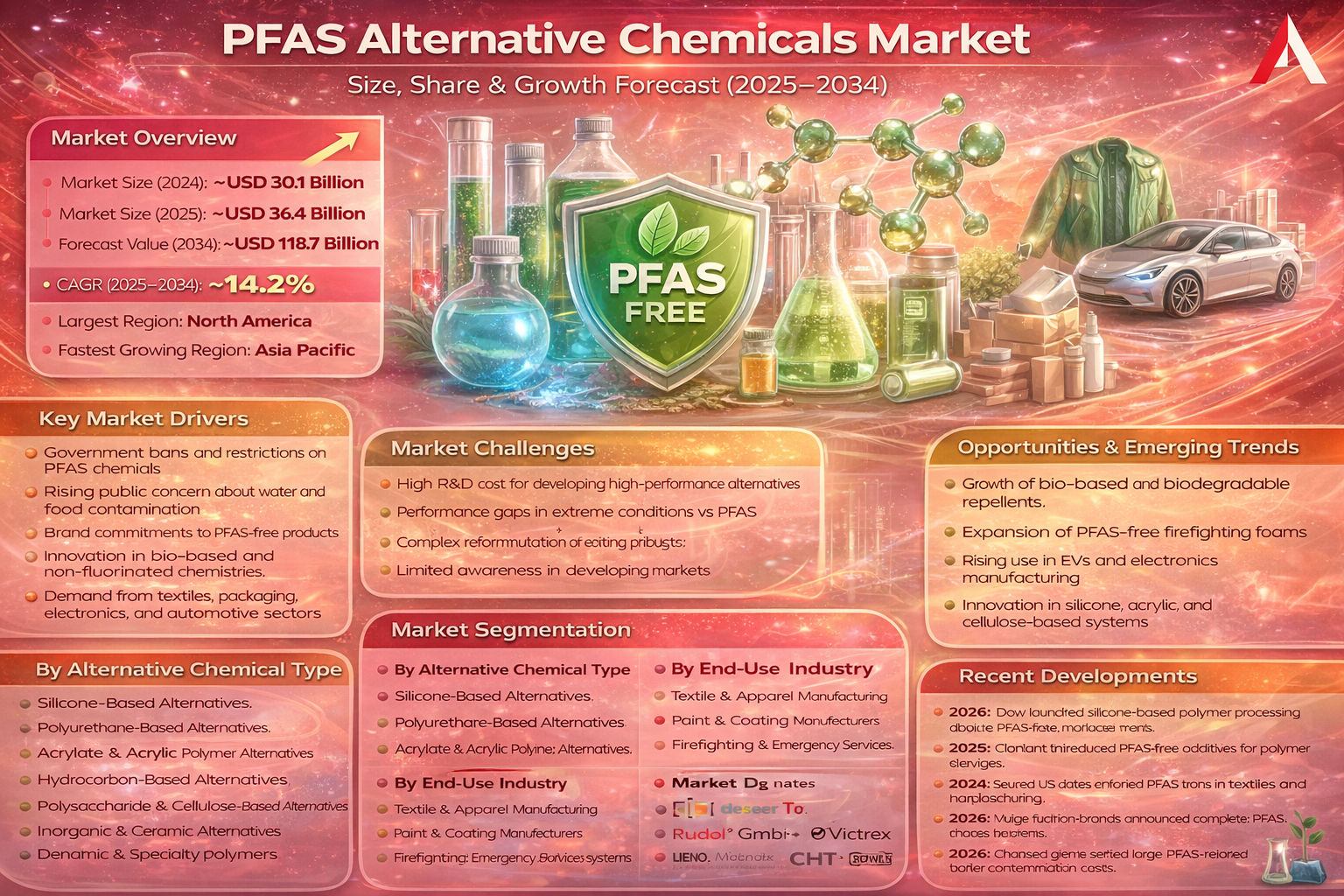
The global PFAS Alternative Chemicals Market was valued at approximately USD 30.1 billion in 2024 and is projected to grow from around USD 36.4 billion in 2025 to nearly USD 118.7 billion by 2034, expanding at a CAGR of about 14.2% during the forecast period.

Rapid regulatory action against PFAS, rising environmental awareness, and increasing demand for safer, non-fluorinated chemicals across textiles, packaging, electronics, automotive, and coatings industries are driving strong growth for PFAS alternative solutions worldwide.
PFAS Alternative Chemicals Market


Market Overview

  • Market Size (2024): ~USD 30.1 Billion
  • Market Size (2025): ~USD 36.4 Billion
  • Forecast Value (2034): ~USD 118.7 Billion
  • CAGR (2025–2034): ~14.2%
  • Largest Region: North America
  • Fastest Growing Region: Asia Pacific

Key Market Drivers

The PFAS alternative chemicals market is expanding rapidly due to strict regulations, corporate sustainability goals, and consumer awareness about health and environmental risks linked to PFAS.

  • Government bans and restrictions on PFAS chemicals
  • Rising public concern about water and food contamination
  • Brand commitments to PFAS-free products
  • Innovation in bio-based and non-fluorinated chemistries
  • Demand from textiles, packaging, electronics, and automotive sectors

Market Challenges

Despite strong growth, the industry faces technical and cost-related barriers.

  • High R&D cost for developing high-performance alternatives
  • Performance gaps in extreme conditions versus PFAS
  • Complex reformulation of existing products
  • Limited awareness in developing markets

Opportunities & Emerging Trends

Continuous innovation and sustainability-driven product development are creating new opportunities.

  • Growth of bio-based and biodegradable repellents
  • Expansion of PFAS-free firefighting foams
  • Rising use in EVs and electronics manufacturing
  • Innovation in silicone, acrylic, and cellulose-based systems

Market Segmentation

By Alternative Chemical Type

  • Silicone-Based Alternatives
  • Polyurethane-Based Alternatives
  • Acrylate & Acrylic Polymer Alternatives
  • Hydrocarbon-Based Alternatives
  • Polysaccharide & Cellulose-Based Alternatives
  • Inorganic & Ceramic Alternatives
  • Organophosphorus Alternatives
  • Dendritic & Specialty Polymers

By End-Use Industry

  • Textile & Apparel Manufacturing
  • Paint & Coating Manufacturers
  • Firefighting & Emergency Services
  • Food & Beverage Packaging
  • Semiconductor & Electronics
  • Automotive Manufacturing
  • Aerospace & Defense
  • Medical Devices
  • Construction & Building Materials

Market Segment Insights

Alternative Type: Silicone-based alternatives lead with about 25–27% share in 2024 due to excellent water repellency, thermal stability, and chemical resistance.

Textiles: Textile and apparel manufacturing accounts for nearly 30% of demand, driven by apparel bans in the US and EU.

Coatings: Paint and coating manufacturers hold about 18% share, using PFAS-free surfactants, defoamers, and wetting agents.

Firefighting: Fluorine-free foams are gaining fast adoption in airports, military bases, and petrochemical facilities.


Regional Analysis

North America: Holds nearly 39% share, driven by US EPA regulations, water safety rules, and state-level bans.

Europe: About 29% share, supported by REACH restrictions and proactive industry adoption.

Asia Pacific: Fastest-growing region due to industrial expansion in China, Japan, and South Korea.

Latin America: Growth led by Brazil and Mexico due to export compliance needs.

MEA: Emerging demand in GCC countries and South Africa.


Competitive Landscape

The PFAS alternative chemicals market is moderately competitive, with innovation, sustainability, and regulatory compliance being key differentiators.

Key Companies

  • Archroma
  • Evonik Industries
  • Dow Inc.
  • Rudolf GmbH
  • Victrex
  • HeiQ Materials
  • NICCA Chemical
  • CHT Group
  • Cerakote

Recent Developments

  • 2025: Dow launched silicone-based polymer processing aids as PFAS-free replacements.
  • 2025: Clariant introduced PFAS-free additives for polymer extrusion.
  • 2024: Several US states enforced PFAS bans in textiles and food packaging.
  • 2024: Major fashion brands announced complete PFAS phase-out plans.
  • 2023: Chemical giants settled large PFAS-related water contamination cases.

Future Outlook

The PFAS alternative chemicals market will continue strong growth through 2034, supported by stricter regulations, corporate sustainability programs, and technological progress. Bio-based surfactants, silicone systems, and cellulose-based chemistries will shape the future of safe, high-performance alternatives.

Regional Outlook

  • North America
    • United States
    • Canada
  • Europe
    • Germany
    • UK
    • France
    • Italy
    • Spain
  • Asia Pacific
    • China
    • India
    • Japan
    • South Korea
    • Australia
  • Latin America
    • Brazil
    • Mexico
    • Argentina
  • Middle East & Africa
    • UAE
    • Saudi Arabia
    • South Africa

PFAS Alternative Chemicals Market – Table of Contents


  • 1. Introduction

    • 1.1 Market Definition

    • 1.2 Scope of the Study

    • 1.3 Research Methodology

    • 1.4 Assumptions & Limitations


  • 2. Executive Summary

    • 2.1 Global PFAS Alternative Chemicals Market Snapshot

    • 2.2 Key Market Highlights

    • 2.3 Market Size & Growth Outlook


  • 3. PFAS Alternative Chemicals Market Overview

    • 3.1 Industry Value Chain Analysis

    • 3.2 Market Ecosystem

    • 3.3 Pricing Analysis


  • 4. Market Dynamics

    • 4.1 Market Drivers

    • 4.2 Market Restraints

    • 4.3 Market Opportunities

    • 4.4 Market Challenges


  • 5. PFAS Alternative Chemicals Market Trends

    • 5.1 Shift Toward Bio-Based Alternatives

    • 5.2 Growth of Non-Fluorinated Coatings

    • 5.3 PFAS-Free Firefighting Foams

    • 5.4 Sustainable Surfactant Development


  • 6. PFAS Alternative Chemicals Market Size & Forecast (2025–2034)

  • 7. Market Segmentation by Alternative Chemical Type

    • 7.1 Silicone-Based Alternatives

    • 7.2 Polyurethane-Based Alternatives

    • 7.3 Acrylate & Acrylic Polymer Alternatives

    • 7.4 Hydrocarbon-Based Alternatives

    • 7.5 Polysaccharide & Cellulose-Based Alternatives

    • 7.6 Inorganic & Ceramic Alternatives

    • 7.7 Organophosphorus Alternatives

    • 7.8 Dendritic & Specialty Polymers


  • 8. Market Segmentation by End-Use Industry

    • 8.1 Textile & Apparel Manufacturing

    • 8.2 Paint & Coating Manufacturers

    • 8.3 Firefighting & Emergency Services

    • 8.4 Food & Beverage Packaging

    • 8.5 Semiconductor & Electronics Manufacturing

    • 8.6 Automotive Manufacturing

    • 8.7 Aerospace & Defense

    • 8.8 Medical Device Manufacturing

    • 8.9 Construction & Building Materials


  • 9. Regional Analysis

    • 9.1 North America

    • 9.2 Europe

    • 9.3 Asia Pacific

    • 9.4 Latin America

    • 9.5 Middle East & Africa


  • 10. Country-Level Market Analysis

    • 10.1 United States

    • 10.2 Canada

    • 10.3 Germany

    • 10.4 UK

    • 10.5 France

    • 10.6 China

    • 10.7 India

    • 10.8 Japan

    • 10.9 Brazil

    • 10.10 UAE


  • 11. Competitive Landscape

    • 11.1 Market Share Analysis

    • 11.2 Competitive Benchmarking

    • 11.3 Strategic Developments


  • 12. PFAS Alternative Chemicals Market Companies

    • 12.1 Company Profiles

    • 12.2 Product Portfolio

    • 12.3 Business Strategies


  • 13. Recent Developments in PFAS Alternative Chemicals Market Industry

  • 14. Investment & Growth Opportunities

  • 15. Analyst Viewpoint

  • 16. Future Outlook

  • 17. Appendix

    • 17.1 Abbreviations

    • 17.2 Research Sources

    • 17.3 Disclaimer


Choose License Type

Single User : $2800


Corporate User : $4800


Need a Tailored Report?

Customize this report to your needs — add regions, segments, or data points, with 20% free customization.

Customize This Report

Frequently Asked Questions

The report efficiently evaluates the market from various dimensions to deliver an end-product that is informative, elaborate, and accurate and includes detailed market segmentation, regional analysis, and competitive landscape of the industry.
The report efficiently evaluates the current market size and provides industry forecast. The market was valued at xx Million US$ in 2019, and is expected to grow at a CAGR of xx% during the period 2020-2027.
The report efficiently evaluates the current market size and provides forecast for the industry in terms of Value (US$ Mn) and Volume (Thousands Units).
Market is segmented by Types, Applications, Technology, End-use Industries, and Regions.
The report presents the current market size, and market forecast, market opportunities, key drivers and restraints, regulatory scenario, industry trend, PESTLE analysis, PORTER’s analysis, new product approvals/launch, promotion and marketing initiatives, pricing analysis, competitive landscape which help businesses in decision making. The analysis data is based on current and historical market trends which help in investment related decisions.
Custom research is crucial components of the business strategy which helps any organization to gain insight into specific business sector, aligned with specific area of interest. Thus, SMI offers more accurate, pragmatic, and actionable information specifically tailored to suit your business needs.

Subscribe Newsletter

  Subscribe