
Market Research Report

PEM Fuel Cell Market Size, Share, Growth Trends & Forecast 2026–2035

  • AMR ID : 1-46
  • CAT ID : 9
  • Pages : 215
  • Date : Jan 2026
 

PEM Fuel Cell Market Size, Share & Growth Forecast (2026–2035)

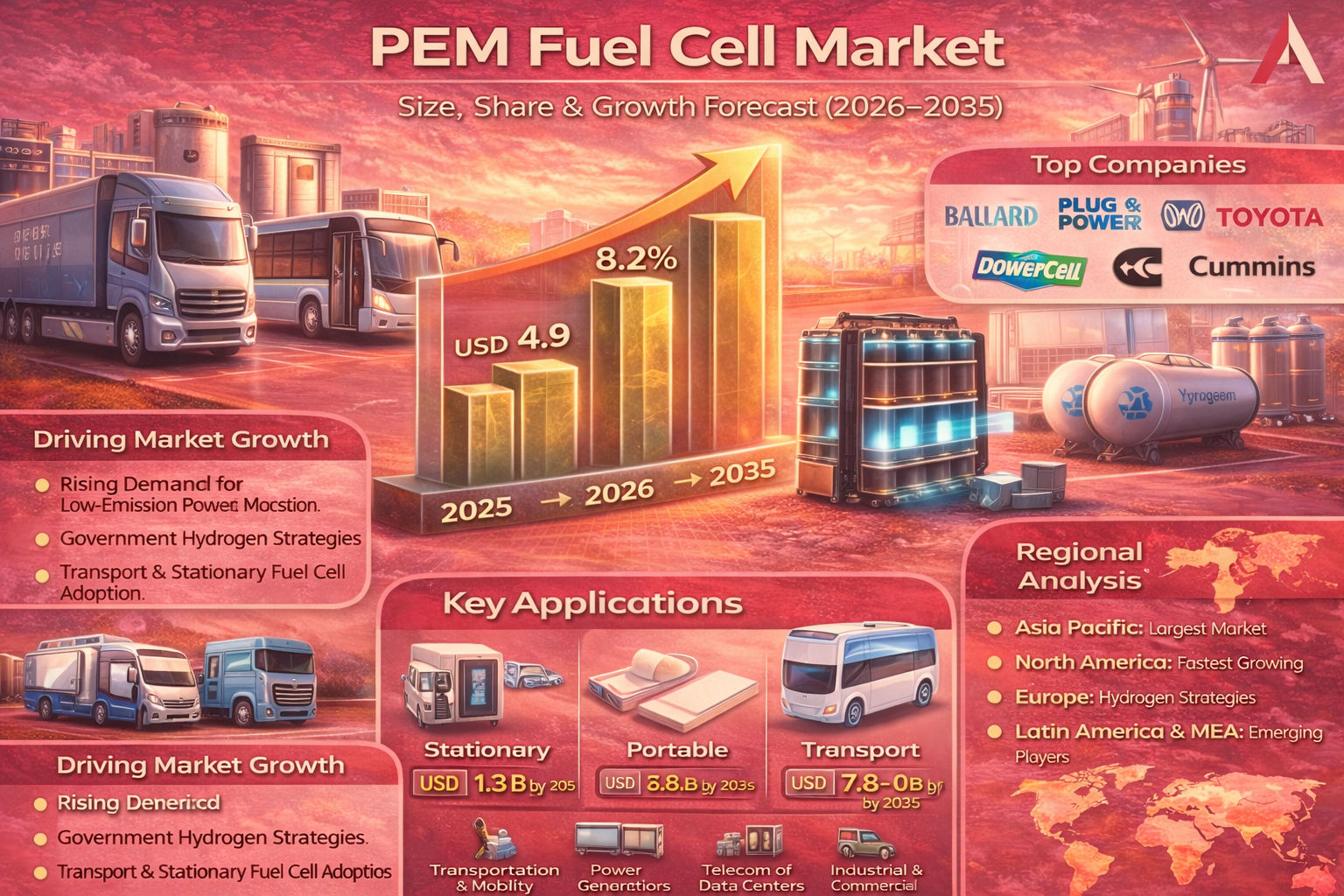
The global PEM fuel cell market was valued at around USD 4.5 billion in 2025 and is projected to grow from nearly USD 4.9 billion in 2026 to about USD 10.2 billion by 2035, expanding at a CAGR of roughly 8.2% during the forecast period. Growth is driven by rising demand for low-emission power systems, government hydrogen strategies, and increasing adoption of fuel cells in transportation, backup power, and distributed energy systems.

PEM Fuel Cell Market table

PEM Fuel Cell Market Overview

Proton Exchange Membrane (PEM) fuel cells are electrochemical devices that convert hydrogen into electricity with water as the only by-product. They are known for fast start-up, high power density, compact size, and suitability for variable load conditions. These features make PEM fuel cells ideal for transport applications, portable power, and stationary backup systems.

Global decarbonization goals, hydrogen economy roadmaps, and investments in renewable energy integration are accelerating PEM fuel cell adoption. Governments across Europe, North America, and Asia-Pacific are supporting hydrogen production, refueling infrastructure, and fuel cell deployment through subsidies, tax credits, and pilot projects.
PEM Fuel Cell Market

Market Dynamics

Drivers

  • Government hydrogen economy strategies and funding programs.
  • Rising demand for zero-emission transport in buses, trucks, and rail.
  • Need for reliable backup and distributed power systems.
  • Technological improvements in membranes, catalysts, and stack design.

Restraints

  • High capital cost of fuel cell stacks and hydrogen infrastructure.
  • Dependence on expensive materials like platinum catalysts.
  • Limited hydrogen refueling and supply networks in many regions.

Opportunities

  • Expansion of hydrogen mobility corridors for heavy-duty vehicles.
  • Growth of data centers, telecom towers, and off-grid power needs.
  • Integration with renewable energy for green hydrogen production.

PEM Fuel Cell Market Trends

The market is witnessing strong momentum from public transportation projects using hydrogen buses and trucks. Several countries are deploying hydrogen-powered fleets supported by dedicated refueling corridors. Another major trend is the use of PEM fuel cells for backup power in telecom, data centers, defense, and remote industrial sites due to their reliability and clean operation.

Advances in membrane durability, catalyst efficiency, and manufacturing automation are gradually reducing system costs and improving lifespan, making PEM fuel cells more competitive with batteries and diesel generators.

Market Segmentation

By Application

  • Stationary: Used in backup power, distributed generation, microgrids, and industrial facilities. This segment is expected to cross USD 1.3 billion by 2035.
  • Portable: Used in drones, military equipment, electronics, and emergency power units. Small but fast-growing segment.
  • Transport: Includes buses, trucks, cars, trains, and marine vessels. This is the largest segment and is projected to exceed USD 7.8–8.0 billion by 2035.

By End-Use Industry

  • Transportation & Mobility
  • Power Generation & Utilities
  • Telecom & Data Centers
  • Defense & Aerospace
  • Industrial & Commercial Facilities

Regional Analysis

Asia Pacific

Asia Pacific is the largest market, driven by strong hydrogen policies in Japan, South Korea, China, and Australia. Countries are investing heavily in hydrogen mobility, fuel cell vehicles, and large-scale electrolyzer projects. By 2035, the region is expected to account for over one-third of global PEM fuel cell demand.

North America

North America is the fastest-growing region, supported by U.S. and Canadian funding programs, DOE-backed R&D, and strong private investment. The U.S. market alone was close to USD 1 billion in 2025 and is expanding rapidly in transport and backup power applications.

Europe

Europe is driven by strict emission targets and hydrogen strategies under the EU Green Deal. Countries like Germany, France, the UK, and the Netherlands are deploying hydrogen buses, trains, and stationary power systems.

Middle East & Africa

Adoption is at an early stage but growing, with Saudi Arabia and UAE investing in green hydrogen and pilot fuel cell projects.

Latin America

Brazil, Chile, and Argentina are exploring PEM fuel cells for transport, mining, and off-grid power, supported by renewable energy resources.

Competitive Landscape

The PEM fuel cell market is moderately concentrated. Top players hold around 40–45% of global share. Competition is driven by innovation, partnerships, regional expansion, and government-supported projects.

Key Companies

  • Ballard Power Systems
  • Plug Power Inc.
  • Toyota Motor Corporation
  • Doosan Fuel Cell
  • PowerCell Sweden
  • Cummins
  • Robert Bosch
  • Hyundai Motor Company
  • Nuvera Fuel Cells
  • Panasonic Corporation

Company Highlights

Ballard Power Systems is a leader in heavy-duty fuel cell engines for buses, trucks, rail, and marine. Plug Power focuses on integrated hydrogen solutions including electrolyzers, fuel cells, and refueling systems. Toyota is expanding fuel cell vehicles and hydrogen mobility solutions globally. Doosan Fuel Cell specializes in stationary and distributed power systems using hydrogen technology.

Recent Developments

  • 2025: Hyundai announced construction of a large hydrogen fuel cell manufacturing plant in South Korea, targeting production of around 30,000 units per year by 2027.
  • 2025: Rapid growth in hydrogen buses across Europe, with registrations rising sharply compared to 2024.
  • 2024: Plug Power partnered with logistics and industrial firms in the U.S. to deploy on-site hydrogen infrastructure and fuel cell forklifts.
  • 2023: Several companies launched new stationary PEM fuel cell systems for commercial and industrial backup power.

Future Outlook

The PEM fuel cell market is expected to grow strongly through 2035, supported by global decarbonization goals, hydrogen economy policies, and demand for clean mobility and reliable power systems. Falling technology costs, better durability, and expanding hydrogen infrastructure will make PEM fuel cells increasingly competitive with batteries and fossil-fuel generators.

Transportation, distributed power, and industrial decarbonization will remain the main growth engines, making PEM fuel cells a key technology in the global energy transition.

PEM Fuel Cell Market – Table of Contents


  • 1. Introduction

    • 1.1 Market Definition

    • 1.2 Scope of the Study

    • 1.3 Research Methodology

    • 1.4 Assumptions & Limitations


  • 2. Executive Summary

    • 2.1 Global PEM Fuel Cell Market Snapshot

    • 2.2 Key Market Highlights

    • 2.3 Market Size & Growth Outlook


  • 3. PEM Fuel Cell Market Overview

    • 3.1 Industry Value Chain Analysis

    • 3.2 Market Ecosystem

    • 3.3 Technology Landscape

    • 3.4 Pricing Analysis


  • 4. Market Dynamics

    • 4.1 Market Drivers

    • 4.2 Market Restraints

    • 4.3 Market Opportunities

    • 4.4 Market Challenges


  • 5. PEM Fuel Cell Market Trends

    • 5.1 Hydrogen Economy Initiatives

    • 5.2 Adoption in Heavy-Duty Transportation

    • 5.3 Advancements in Membrane & Catalyst Technology

    • 5.4 Growth of Distributed & Backup Power Systems


  • 6. PEM Fuel Cell Market Size & Forecast (2026–2035)

  • 7. Market Segmentation by Application

    • 7.1 Stationary

    • 7.2 Portable

    • 7.3 Transport


  • 8. Market Segmentation by End-Use Industry

    • 8.1 Transportation & Mobility

    • 8.2 Power Generation & Utilities

    • 8.3 Telecom & Data Centers

    • 8.4 Industrial & Commercial

    • 8.5 Defense & Aerospace

    • 8.6 Others


  • 9. Market Segmentation by Power Output

    • 9.1 Below 10 kW

    • 9.2 10–100 kW

    • 9.3 Above 100 kW


  • 10. Market Segmentation by Component

    • 10.1 Stack

    • 10.2 Membrane Electrode Assembly (MEA)

    • 10.3 Bipolar Plates

    • 10.4 Balance of Plant (BoP)


  • 11. Regional Analysis

    • 11.1 North America

    • 11.2 Europe

    • 11.3 Asia Pacific

    • 11.4 Latin America

    • 11.5 Middle East & Africa


  • 12. Country-Level Market Analysis

    • 12.1 United States

    • 12.2 Canada

    • 12.3 Germany

    • 12.4 United Kingdom

    • 12.5 France

    • 12.6 China

    • 12.7 Japan

    • 12.8 South Korea

    • 12.9 India

    • 12.10 Australia


  • 13. Competitive Landscape

    • 13.1 Market Share Analysis

    • 13.2 Competitive Benchmarking

    • 13.3 Strategic Developments

    • 13.4 Mergers & Acquisitions

    • 13.5 Partnerships & Collaborations


  • 14. PEM Fuel Cell Market Companies

    • 14.1 Company Profiles

    • 14.2 Product Portfolio

    • 14.3 Technology & Innovation Focus

    • 14.4 Business Strategies


  • 15. Investment & Funding Analysis

  • 16. Recent Developments in PEM Fuel Cell Market

  • 17. Analyst Viewpoint

  • 18. Future Outlook

  • 19. Appendix

    • 19.1 Abbreviations

    • 19.2 Research Sources

    • 19.3 Disclaimer


Choose License Type

Single User : $3200


Corporate User : $4800


Need a Tailored Report?

Customize this report to your needs — add regions, segments, or data points, with 20% free customization.

Customize This Report

Frequently Asked Questions

The report efficiently evaluates the market from various dimensions to deliver an end-product that is informative, elaborate, and accurate and includes detailed market segmentation, regional analysis, and competitive landscape of the industry.
The report efficiently evaluates the current market size and provides industry forecast. The market was valued at xx Million US$ in 2019, and is expected to grow at a CAGR of xx% during the period 2020-2027.
The report efficiently evaluates the current market size and provides forecast for the industry in terms of Value (US$ Mn) and Volume (Thousands Units).
Market is segmented by Types, Applications, Technology, End-use Industries, and Regions.
The report presents the current market size, and market forecast, market opportunities, key drivers and restraints, regulatory scenario, industry trend, PESTLE analysis, PORTER’s analysis, new product approvals/launch, promotion and marketing initiatives, pricing analysis, competitive landscape which help businesses in decision making. The analysis data is based on current and historical market trends which help in investment related decisions.
Custom research is crucial components of the business strategy which helps any organization to gain insight into specific business sector, aligned with specific area of interest. Thus, SMI offers more accurate, pragmatic, and actionable information specifically tailored to suit your business needs.

Subscribe Newsletter

  Subscribe