
Market Research Report

HVAC Air Handling Units Market Size, Share, Growth Trends, Industry Analysis & Forecast 2026–2035

  • AMR ID : 1-53
  • CAT ID : 11
  • Pages : 210
  • Date : Jan 2026
 

HVAC Air Handling Units Market Overview

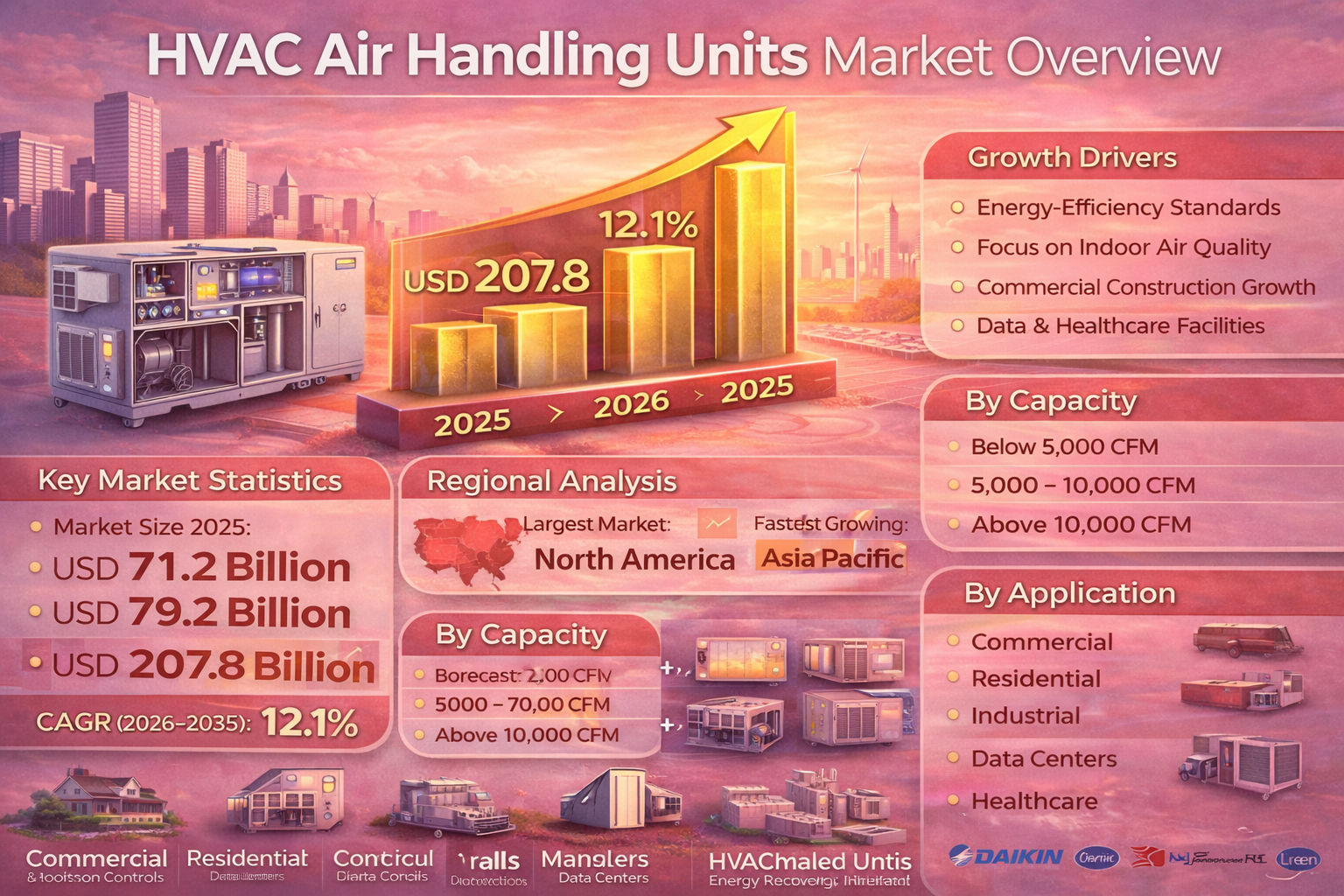
The global HVAC Air Handling Units (AHU) market was valued at approximately USD 71.2 billion in 2025 and is projected to expand steadily, reaching nearly USD 207.8 billion by 2035, growing at a CAGR of around 12.1% during the forecast period. Market growth is supported by rapid urbanization, expanding commercial infrastructure, rising awareness of indoor air quality (IAQ), and increasingly stringent energy-efficiency regulations worldwide.

Air handling units play a critical role in modern HVAC systems by conditioning, filtering, and circulating air across residential, commercial, and industrial buildings. As buildings become smarter, denser, and more energy conscious, demand for advanced, modular, and high-efficiency AHUs continues to accelerate.
HVAC Air Handling Units Market

Key Market Statistics

  • Market Size (2025): USD 71.2 Billion
  • Market Size (2026): USD 79.2 Billion
  • Market Size (2035): USD 207.8 Billion
  • CAGR (2026–2035): 12.1%
  • Largest Region: North America
  • Fastest Growing Region: Asia Pacific

Market Dynamics

Growth Drivers

  • Stringent global energy-efficiency standards (ASHRAE, EU Ecodesign)
  • Rising focus on indoor air quality and occupant health
  • Growth in commercial construction and infrastructure development
  • Increasing demand from data centers and healthcare facilities

Market Restraints

  • High upfront cost of advanced AHU systems
  • Complex installation and maintenance requirements
  • Supply chain volatility and raw material price fluctuations

Opportunities

  • Rising demand for precision cooling in data centers
  • Integration with IoT, AI, and smart building management systems
  • Retrofit and replacement of aging HVAC infrastructure

HVAC Air Handling Units Market Trends

The AHU market is witnessing a strong shift toward energy recovery ventilators (ERVs), electronically commutated (EC) fans, and direct-drive systems. These technologies significantly reduce energy consumption while improving airflow precision and system reliability.

Another key trend is the rapid adoption of advanced filtration technologies, including MERV 13+ and HEPA filters, particularly in hospitals, cleanrooms, educational institutions, and high-end commercial buildings. Smart AHUs equipped with sensors and cloud-connected controls are enabling predictive maintenance, real-time monitoring, and optimized ventilation.

Market Segmentation

By Component

  • Filters
  • Heating & Cooling Coils
  • Dampers
  • Fans
  • Air Handlers
  • Blowers
  • Others (humidifiers, dehumidifiers, isolators)

The filters segment dominates the market due to continuous replacement demand and growing IAQ regulations, while coils and dampers maintain strong growth driven by energy-efficiency upgrades.

By Capacity

  • Below 5,000 CFM
  • 5,000 – 10,000 CFM
  • Above 10,000 CFM

Units below 5,000 CFM lead the market due to their extensive use in small and mid-sized commercial buildings, while high-capacity AHUs are rapidly gaining traction in data centers, airports, and hospitals.

By Application

  • Residential Buildings
  • Commercial Buildings
  • Industrial Facilities

Applications of HVAC Air Handling Units

  • Commercial Offices and IT Parks
  • Hospitals and Healthcare Facilities
  • Data Centers and Cloud Infrastructure
  • Educational Institutions
  • Manufacturing and Industrial Plants
  • Airports, Malls, and Large Public Buildings

Regional Analysis

North America

North America dominates the global AHU market due to strict energy regulations, a mature commercial building base, and strong adoption of smart HVAC systems. The U.S. leads regional growth, supported by data center expansion and energy retrofit projects.

Europe

Europe shows strong demand driven by sustainability mandates, green building certifications, and replacement of aging HVAC systems. Germany, the UK, and France are key contributors.

Asia Pacific

Asia Pacific is the fastest-growing region, fueled by rapid urbanization, infrastructure investments, and rising demand for centralized HVAC systems in China and India.

Latin America & Middle East

These regions are witnessing steady growth supported by commercial construction, improving comfort standards, and modernization of HVAC infrastructure.

Competitive Landscape

The HVAC air handling units market is moderately consolidated, with global manufacturers competing through technological innovation, energy efficiency, and customization capabilities.

Key Players

  • Daikin Industries Ltd.
  • Carrier Global Corporation
  • LG Electronics Inc.
  • Johnson Controls International plc
  • Lennox International Inc.
  • Trane Technologies plc
  • Mitsubishi Electric Corporation
  • Systemair AB
  • Munters Group AB
  • Rheem Manufacturing Company

Recent Developments

  • 2025: Daikin expanded its data center cooling portfolio through strategic investments in advanced thermal management technologies.
  • 2024: Trane Technologies collaborated with AI platform providers to launch smart AHUs with predictive optimization capabilities.
  • 2024: Johnson Controls announced expansion of high-efficiency HVAC manufacturing facilities to support electrification trends.
  • 2024: Multiple OEMs introduced compact, modular AHUs designed for decentralized ventilation and green building compliance.

Future Outlook

The HVAC Air Handling Units market is expected to witness sustained long-term growth as energy efficiency, indoor air quality, and smart building technologies become standard requirements. Data center expansion, healthcare infrastructure growth, and tightening environmental regulations will continue to drive innovation and demand for advanced AHU solutions globally.

HVAC Air Handling Units Market – Table of Contents


  • 1. Introduction

    • 1.1 Market Definition

    • 1.2 Scope of the Study

    • 1.3 Research Methodology

    • 1.4 Assumptions & Limitations


  • 2. Executive Summary

    • 2.1 Global HVAC Air Handling Units Market Snapshot

    • 2.2 Key Market Highlights

    • 2.3 Market Size & Growth Outlook


  • 3. HVAC Air Handling Units Market Overview

    • 3.1 Industry Value Chain Analysis

    • 3.2 Market Ecosystem

    • 3.3 Pricing Analysis

    • 3.4 Technology Landscape


  • 4. Market Dynamics

    • 4.1 Market Drivers

    • 4.2 Market Restraints

    • 4.3 Market Opportunities

    • 4.4 Market Challenges


  • 5. HVAC Air Handling Units Market Trends

    • 5.1 Energy-Efficient & EC Fan-Based AHUs

    • 5.2 Indoor Air Quality (IAQ) & Advanced Filtration

    • 5.3 Smart & IoT-Enabled AHUs

    • 5.4 Modular & Compact AHU Designs


  • 6. HVAC Air Handling Units Market Size & Forecast (2025–2035)

  • 7. Market Segmentation by Component

    • 7.1 Filters

    • 7.2 Heating & Cooling Coils

    • 7.3 Dampers

    • 7.4 Fans

    • 7.5 Air Handlers

    • 7.6 Blowers

    • 7.7 Other Components


  • 8. Market Segmentation by Capacity

    • 8.1 Below 5,000 CFM

    • 8.2 5,000 – 10,000 CFM

    • 8.3 Above 10,000 CFM


  • 9. Market Segmentation by Application

    • 9.1 Residential

    • 9.2 Commercial

    • 9.3 Industrial


  • 10. Market Segmentation by Distribution Channel

    • 10.1 Direct Sales

    • 10.2 Indirect Sales


  • 11. Regional Analysis

    • 11.1 North America

    • 11.2 Europe

    • 11.3 Asia Pacific

    • 11.4 Latin America

    • 11.5 Middle East & Africa


  • 12. Country-Level Market Analysis

    • 12.1 United States

    • 12.2 Canada

    • 12.3 Germany

    • 12.4 UK

    • 12.5 France

    • 12.6 China

    • 12.7 India

    • 12.8 Japan

    • 12.9 Brazil

    • 12.10 Saudi Arabia


  • 13. Competitive Landscape

    • 13.1 Market Share Analysis

    • 13.2 Competitive Benchmarking

    • 13.3 Strategic Initiatives


  • 14. HVAC Air Handling Units Market Companies

    • 14.1 Company Profiles

    • 14.2 Product Portfolio

    • 14.3 Business Strategies


  • 15. Recent Developments in HVAC Air Handling Units Market

  • 16. Investment & Growth Opportunities

  • 17. Analyst Viewpoint

  • 18. Future Outlook

  • 19. Appendix

    • 19.1 Abbreviations

    • 19.2 Research Sources

    • 19.3 Disclaimer


Choose License Type

Single User : $3200


Corporate User : $4800


Need a Tailored Report?

Customize this report to your needs — add regions, segments, or data points, with 20% free customization.

Customize This Report

Frequently Asked Questions

The report efficiently evaluates the market from various dimensions to deliver an end-product that is informative, elaborate, and accurate and includes detailed market segmentation, regional analysis, and competitive landscape of the industry.
The report efficiently evaluates the current market size and provides industry forecast. The market was valued at xx Million US$ in 2019, and is expected to grow at a CAGR of xx% during the period 2020-2027.
The report efficiently evaluates the current market size and provides forecast for the industry in terms of Value (US$ Mn) and Volume (Thousands Units).
Market is segmented by Types, Applications, Technology, End-use Industries, and Regions.
The report presents the current market size, and market forecast, market opportunities, key drivers and restraints, regulatory scenario, industry trend, PESTLE analysis, PORTER’s analysis, new product approvals/launch, promotion and marketing initiatives, pricing analysis, competitive landscape which help businesses in decision making. The analysis data is based on current and historical market trends which help in investment related decisions.
Custom research is crucial components of the business strategy which helps any organization to gain insight into specific business sector, aligned with specific area of interest. Thus, SMI offers more accurate, pragmatic, and actionable information specifically tailored to suit your business needs.

Subscribe Newsletter

  Subscribe