
Market Research Report

Automotive Digital Twin Hardware Market Size, Opportunity, Growth Drivers, Industry Trend Analysis, and Forecast 2025-2034

  • AMR ID : 1-48
  • CAT ID : 5
  • Pages : 221
  • Date : Jan 2026
 

Automotive Digital Twin Hardware Market Size, Share, Trends & Forecast (2025–2034)

Market Overview

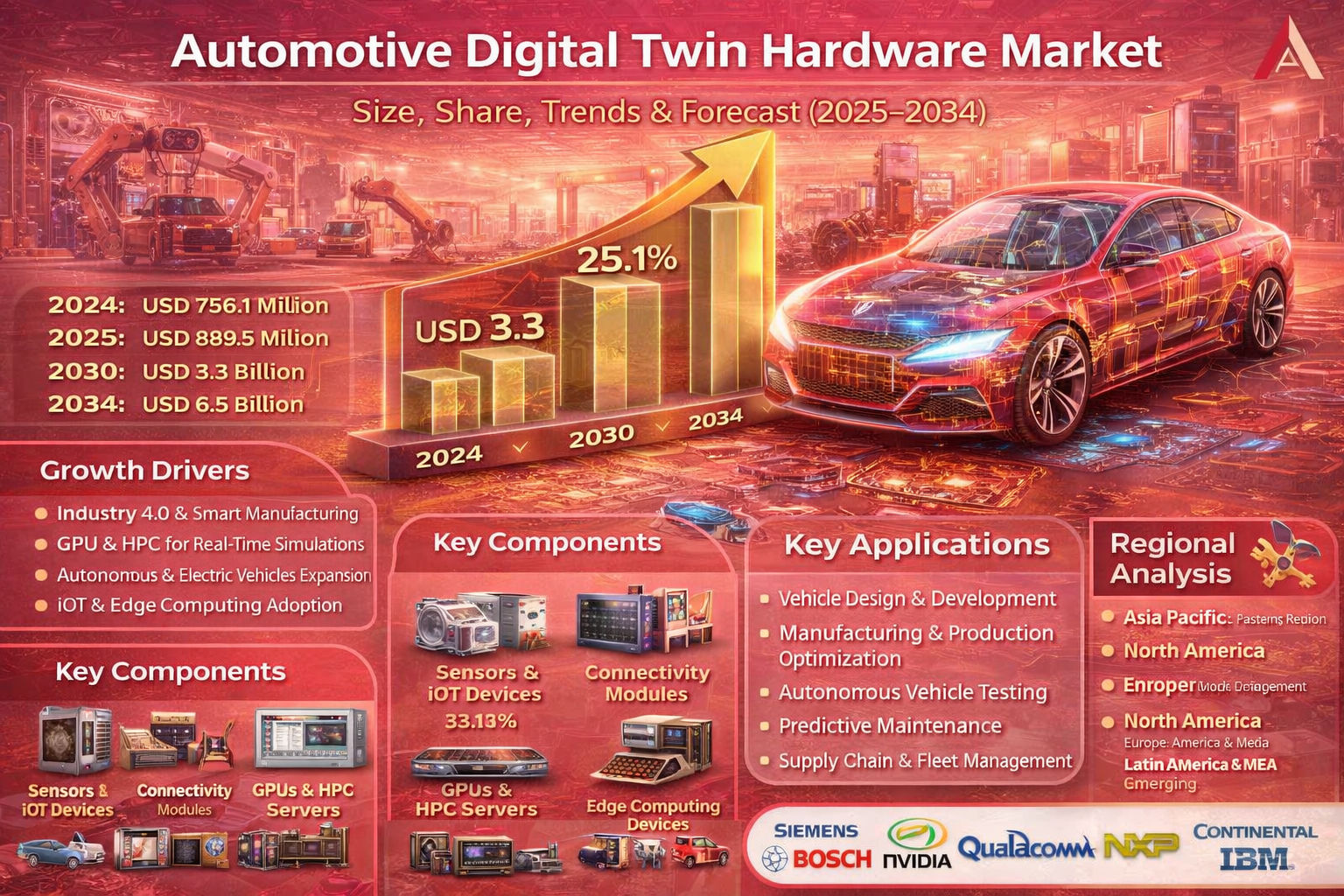
The global automotive digital twin hardware market was valued at nearly USD 756.1 million in 2024 and is expected to grow rapidly to around USD 6.5 billion by 2034, expanding at a CAGR of approximately 25.1% during 2025–2034. The market includes hardware such as sensors, IoT devices, GPUs, edge computing systems, connectivity modules, controllers, and high-performance computing (HPC) servers used to build and operate digital twins of vehicles, factories, and supply chains.

Automotive OEMs and Tier-1 suppliers are using digital twin hardware to simulate real-world vehicle behavior, manufacturing workflows, and system performance. These platforms allow virtual testing of powertrains, ADAS, autonomous driving, battery systems, and assembly lines before physical deployment, reducing cost, time-to-market, and operational risks.
Automotive Digital Twin Hardware Market

Market Dynamics

Growth Drivers

  • Rising adoption of Industry 4.0 and smart manufacturing
  • Growing use of GPUs and HPC for real-time vehicle and factory simulations
  • Expansion of autonomous, connected, and electric vehicles
  • Adoption of IoT and edge computing for predictive maintenance
  • Integration of AI and machine learning hardware

Challenges

  • High upfront cost of GPUs, edge servers, and HPC infrastructure
  • Integration issues across CAD, PLM, IoT, and AI systems
  • Data security and interoperability concerns

Opportunities

  • AI-accelerated simulation hardware for autonomous vehicles
  • 5G and low-latency networks enabling real-time synchronization
  • Expansion of digital twin hardware in EV and battery systems
  • Edge-cloud hybrid digital twin infrastructure

Market Trends

Automotive manufacturers are increasingly deploying IoT sensors, edge computing devices, and GPU-based simulation servers to build digital twins of vehicles and factories. These systems enable real-time visualization, predictive maintenance, and performance optimization.

AI-driven simulations combined with 3D modeling and big data analytics are reducing reliance on physical prototypes. This shift cuts development cost and accelerates product launches. With the growth of robotics in factories, digital twin hardware is also being used to calibrate robots and automate production lines.

The adoption of 5G and ultra-low latency networks is further enabling live synchronization between physical vehicles and their digital replicas. This trend is critical for autonomous vehicle validation and connected mobility solutions.

Market Size Trend

  • 2024: USD 756.1 Million
  • 2025: USD 889.5 Million
  • 2030: USD 3.3 Billion
  • 2034: USD 6.5 Billion

Market Segmentation

By Component

  • Sensors & IoT Devices – Largest share (33.1% in 2024)
  • Edge Computing Devices
  • Connectivity & Networking Hardware
  • Actuators & Control Systems
  • High-Performance Computing / Simulation Hardware

Sensors and IoT devices dominate the market due to their role in capturing real-time data such as temperature, vibration, pressure, and location. HPC and GPU-based simulation hardware is expected to grow fastest with a CAGR of over 26% due to autonomous and EV simulation needs.

By Vehicle Type

  • Passenger Cars – 71.8% share in 2024
  • Commercial Vehicles
  • Electric Vehicles

Passenger cars dominate due to rising ADAS, connectivity, and software-defined vehicle adoption. Electric vehicles are the fastest-growing segment because digital twins are widely used for battery, thermal, and powertrain simulations.

By Application

  • Vehicle Design & Development
  • Manufacturing & Production Optimization
  • Predictive Maintenance
  • Autonomous Vehicle Testing
  • Supply Chain & Fleet Management

Vehicle design and development is projected to account for around 42% share by 2034 due to the need for virtual prototyping, powertrain testing, and autonomous system validation.

By Deployment Mode

  • On-Premises – 74.8% share in 2024
  • Cloud
  • Hybrid

On-premises deployment dominates due to data security, latency requirements, and real-time simulation needs. Hybrid and cloud models are gaining popularity for global collaboration and scalability.

Regional Analysis

North America

North America held around 35% market share in 2024. The U.S. leads due to early adoption of AI, GPUs, edge computing, and smart manufacturing. Strong presence of technology providers and government support for Industry 4.0 drives growth.

Asia Pacific

Asia Pacific is the fastest-growing region with CAGR near 27%. China, Japan, South Korea, and India are investing heavily in smart factories, EVs, and autonomous driving, boosting demand for digital twin hardware.

Europe

Europe accounted for around USD 190–200 million in 2024. Growth is driven by Industry 4.0, EV adoption, and collaborations between automakers and tech firms in Germany, France, and the Netherlands.

Latin America & MEA

Brazil leads Latin America due to EV adoption and smart factory initiatives. South Africa, Saudi Arabia, and UAE are emerging markets supported by manufacturing modernization and digitalization programs.

Competitive Landscape

Top companies collectively hold around 48% market share. Competition is driven by GPU performance, AI integration, edge computing capability, and system compatibility.

Key Players

  • Siemens
  • Bosch
  • NVIDIA
  • Qualcomm
  • NXP Semiconductors
  • Continental
  • General Electric
  • IBM
  • Molex
  • PTC

Company Insights

NVIDIA: Leader in GPU-accelerated simulation with DRIVE and Omniverse platforms for autonomous vehicles and factory digital twins.

Siemens: Xcelerator and Teamcenter platforms integrate automation hardware, simulation tools, and IoT for smart factories and vehicle design.

Bosch: Strong in sensors, electronics, and edge computing for real-time monitoring and predictive maintenance.

Qualcomm: Snapdragon Ride and Digital Chassis integrate AI, 5G, and edge computing for connected vehicles.

NXP: Provides microcontrollers, processors, and secure connectivity for automotive digital twin ecosystems.

Recent Developments

  • Oct 2025: NVIDIA and BMW deployed GPU-based digital twin hardware across European plants for real-time assembly simulation.
  • Sep 2025: Bosch and Volkswagen partnered to build IoT-enabled digital twin platforms for EV powertrains.
  • Feb 2025: Siemens upgraded Xcelerator hardware with AI-driven analytics for real-time factory simulation.
  • Feb 2025: NXP launched new microcontrollers and secure connectivity solutions for automotive digital twins.
  • Oct 2024: Ola Electric launched GPU-powered digital twin platform using NVIDIA Omniverse and Krutrim AI.

Future Outlook

The automotive digital twin hardware market is set for rapid growth over the next decade. Advances in GPUs, AI processors, edge computing, and 5G will enable highly accurate, real-time simulations. Digital twin hardware will become essential for autonomous vehicles, EV development, smart factories, and connected mobility, making it a core component of the future automotive ecosystem.

Automotive Digital Twin Hardware Market – Table of Contents


  • 1. Introduction

    • 1.1 Market Definition

    • 1.2 Scope of the Study

    • 1.3 Research Methodology

    • 1.4 Assumptions & Limitations


  • 2. Executive Summary

    • 2.1 Global Automotive Digital Twin Hardware Market Snapshot

    • 2.2 Key Market Highlights

    • 2.3 Market Size & Growth Outlook


  • 3. Automotive Digital Twin Hardware Market Overview

    • 3.1 Industry Value Chain Analysis

    • 3.2 Market Ecosystem

    • 3.3 Pricing Analysis

    • 3.4 Technology Landscape

    • 3.5 Digital Twin Architecture in Automotive


  • 4. Market Dynamics

    • 4.1 Market Drivers

    • 4.2 Market Restraints

    • 4.3 Market Opportunities

    • 4.4 Market Challenges


  • 5. Automotive Digital Twin Hardware Market Trends

    • 5.1 GPU-Accelerated Simulation

    • 5.2 Edge Computing & IoT Hardware

    • 5.3 AI & ML Hardware Integration

    • 5.4 5G & Real-Time Connectivity

    • 5.5 Industry 4.0 & Smart Factories


  • 6. Automotive Digital Twin Hardware Market Size & Forecast (2025–2034)

  • 7. Market Segmentation by Component

    • 7.1 Sensors & IoT Devices

    • 7.2 Edge Computing Devices

    • 7.3 Connectivity & Networking Hardware

    • 7.4 Actuators & Control Systems

    • 7.5 High-Performance Computing / Simulation Hardware


  • 8. Market Segmentation by Vehicle Type

    • 8.1 Passenger Cars

    • 8.2 Commercial Vehicles

    • 8.3 Electric Vehicles (EVs)


  • 9. Market Segmentation by Application

    • 9.1 Vehicle Design & Development

    • 9.2 Manufacturing & Production Optimization

    • 9.3 Predictive Maintenance

    • 9.4 Autonomous Vehicle Testing

    • 9.5 Supply Chain & Fleet Management


  • 10. Market Segmentation by Deployment Mode

    • 10.1 On-Premises

    • 10.2 Cloud-Based

    • 10.3 Hybrid


  • 11. Regional Analysis

    • 11.1 North America

    • 11.2 Europe

    • 11.3 Asia Pacific

    • 11.4 Latin America

    • 11.5 Middle East & Africa


  • 12. Country-Level Market Analysis

    • 12.1 United States

    • 12.2 Canada

    • 12.3 Germany

    • 12.4 UK

    • 12.5 France

    • 12.6 China

    • 12.7 Japan

    • 12.8 India

    • 12.9 South Korea

    • 12.10 Brazil

    • 12.11 UAE

    • 12.12 South Africa


  • 13. Competitive Landscape

    • 13.1 Market Share Analysis

    • 13.2 Competitive Benchmarking

    • 13.3 Strategic Developments


  • 14. Automotive Digital Twin Hardware Market Companies

    • 14.1 Company Profiles

    • 14.2 Product Portfolio

    • 14.3 Business Strategies


  • 15. Recent Developments in Automotive Digital Twin Hardware Industry

  • 16. Investment & Growth Opportunities

  • 17. Analyst Viewpoint

  • 18. Future Outlook

  • 19. Appendix

    • 19.1 Abbreviations

    • 19.2 Research Sources

    • 19.3 Disclaimer


Choose License Type

Single User : $3200


Corporate User : $4800


Need a Tailored Report?

Customize this report to your needs — add regions, segments, or data points, with 20% free customization.

Customize This Report

Frequently Asked Questions

The report efficiently evaluates the market from various dimensions to deliver an end-product that is informative, elaborate, and accurate and includes detailed market segmentation, regional analysis, and competitive landscape of the industry.
The report efficiently evaluates the current market size and provides industry forecast. The market was valued at xx Million US$ in 2019, and is expected to grow at a CAGR of xx% during the period 2020-2027.
The report efficiently evaluates the current market size and provides forecast for the industry in terms of Value (US$ Mn) and Volume (Thousands Units).
Market is segmented by Types, Applications, Technology, End-use Industries, and Regions.
The report presents the current market size, and market forecast, market opportunities, key drivers and restraints, regulatory scenario, industry trend, PESTLE analysis, PORTER’s analysis, new product approvals/launch, promotion and marketing initiatives, pricing analysis, competitive landscape which help businesses in decision making. The analysis data is based on current and historical market trends which help in investment related decisions.
Custom research is crucial components of the business strategy which helps any organization to gain insight into specific business sector, aligned with specific area of interest. Thus, SMI offers more accurate, pragmatic, and actionable information specifically tailored to suit your business needs.

Subscribe Newsletter

  Subscribe